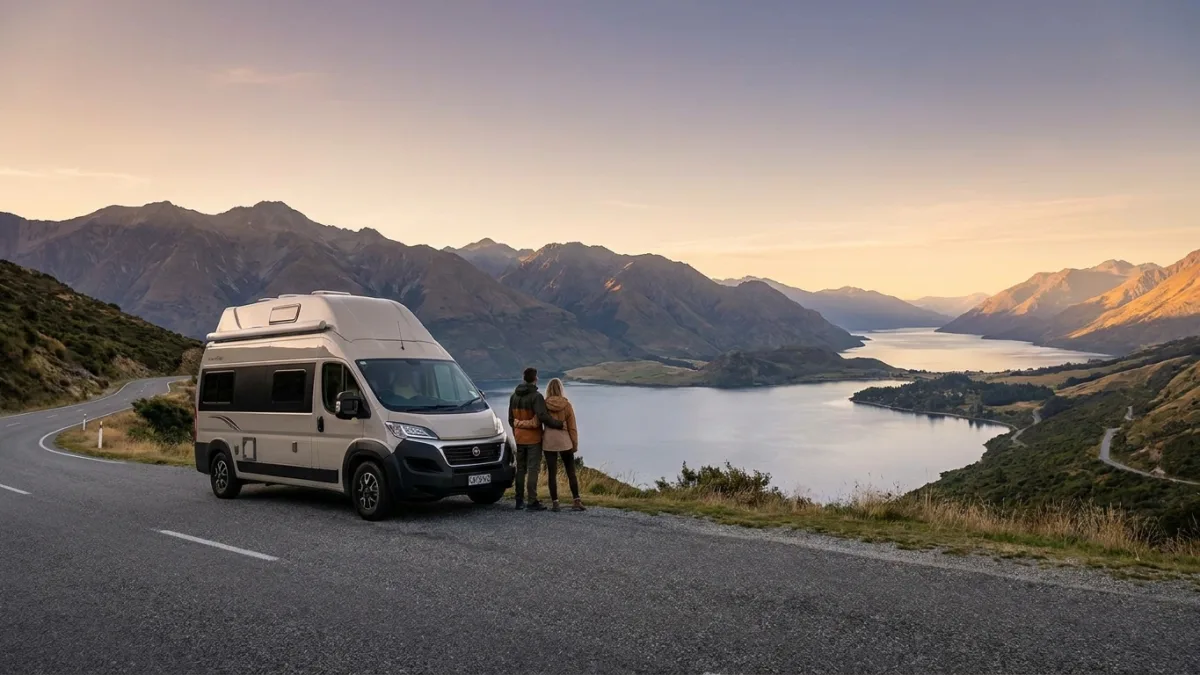

Book smart, save thousands, and avoid the traps that catch first-time campervan renters.
Booking Timeline
Book 3-6 months ahead for summer travel. Shoulder seasons need 4-8 weeks. Last-minute bookings cost significantly more with limited vehicle choice.Smart Savings
Shoulder season rates drop massively compared to peak summer rates. Monday-Friday pickups unlock discounts. Self-contained certification saves on campsite fees and gives more flexibility.Common Traps
Hidden fees include kilometer overages, young driver surcharges, cleaning charges, and one-way fees. Insurance excess can reach $7,500 without proper coverage.
Renting a campervan in New Zealand can feel overwhelming with dozens of companies, confusing insurance options, and seasonal pricing that swings wildly. I've broken down exactly when to book, which vehicle size actually works on Kiwi roads, and the hidden fees that double your costs if you're not careful.
Why Booking Your Campervan Early Changes Everything
Book 6+ months ahead (Dec-Feb)
Holiday Peaks
Book 4-6 months ahead (Christmas)
Shoulder Season
Book 4-8 weeks ahead (Mar-May)
Winter Travel
Book 2-4 weeks ahead (Jun-Aug)
Timing your campervan booking can save you thousands of dollars or leave you scrambling for overpriced options. The sweet spot is 3-6 months ahead for peak season (December-February), while shoulder season bookings can work with just 4-8 weeks notice. Here’s what you need to know about the booking timeline.
New Zealand’s campervan rental market operates on extreme seasonal fluctuations, with tourism rebounding stronger than ever and rental rates climbing. During summer holidays, rental companies can charge significantly more than their winter rates, and availability vanishes weeks before Christmas. The early bird genuinely gets the worm here.
>>> CHECK OUT CURRENT PRICES <<<
Peak Season Booking Windows
For travel between December and February, start your search no later than September. Popular routes like Auckland to Queenstown or Christchurch to Milford Sound get booked solid by October. You’ll face limited vehicle selection after that, often stuck with either massive 6-berth motorhomes (when you only need 2 beds) or budget vans with mechanical issues.
The Christmas to New Year period requires even more foresight. Aim for 4-6 months advance booking if you’re traveling December 20-January 10. Some rental companies open their booking systems a full year ahead specifically for this window.
Shoulder Season Flexibility
April-May and September-November offer the best balance of weather, pricing, and availability. You can book 4-6 weeks out and still find excellent deals. Rental companies lower their rates outside the peak summer season, with the lowest campervan prices typically from May to August, and cheaper shoulder rates in March-April and September-November.
These months also mean fewer crowds at campsites, easier parking at popular spots, and more flexibility to change your route. The weather remains surprisingly good, especially in the North Island where autumn temperatures stay mild.
Last-Minute Booking Traps
Booking within 2 weeks of pickup rarely works in your favor. You’ll pay premium rates, face limited insurance options, and often get stuck with poorly maintained vehicles that other renters rejected. The “deals” you might find are usually relocation specials with strict one-way requirements that force you into inconvenient routes.
Critical Point: Never assume you can “find something when you arrive.” During peak season, you risk paying significantly more per day for a basic van, or worse, finding nothing available within 200km of your arrival city.
Choosing the Right Vehicle Size for New Zealand Roads
- Fits standard parking
- 9-11L fuel per 100km
- Access all campsites
- Easy maneuverability
- Built-in bathroom
- More living space
- Family-friendly
- Higher campsite fees
Vehicle selection goes far beyond counting beds. New Zealand’s roads punish oversized motorhomes with tight corners, narrow bridges, and challenging mountain passes. Your choice directly impacts fuel costs, campsite access, and daily driving stress.
The 2-Berth Sweet Spot
For couples or solo travelers, 2-berth campervans (5-6 meters long) dominate the rental market for good reason. They fit into standard parking spaces, handle winding roads confidently, and access nearly every campsite. Fuel consumption averages 9-11 liters per 100km, manageable on New Zealand’s fuel prices.
According to GlobalPetrolPrices.com, petrol prices in New Zealand have fluctuated significantly, with recent data showing prices around NZ$3.00-3.50 per liter as of early 2026, though prices spiked higher during the 2026 fuel crisis.
These vans typically include a small kitchen, basic storage, and a bed that converts from the seating area. You won’t have a bathroom, but New Zealand’s excellent network of public facilities and holiday parks makes this a non-issue for most travelers.
When Bigger Makes Sense
4-6 berth motorhomes (7-9 meters) suit families or groups willing to trade maneuverability for space. The built-in toilet and shower become valuable on multi-week trips or when traveling with children. However, expect fuel costs to increase significantly (larger motorhomes can use 11-20 liters per 100km) and campsite fees to increase, as many sites charge by vehicle length.
Large motorhomes struggle on routes like the Crown Range Road or Skippers Canyon. You’ll need to plan alternative routes or skip certain attractions entirely. Some rental companies explicitly prohibit their larger vehicles on specific roads.
The Self-Contained Certification Advantage
New Zealand law requires self-contained certification for freedom camping in most areas. According to the Plumbers, Gasfitters and Drainlayers Board, from 7 June 2026, all vehicles must have a ‘green warrant’ to be certified self-contained. This means your vehicle must have:
- Fixed toilet (portable toilets no longer meet the standard – vehicles must have a permanently fixed toilet)
- Fixed freshwater tank (minimum 12 liters per person for 3 days)
- Wastewater collection system
- Proper ventilation system
- Sink with trap and drain
- Rubbish storage
Non-self-contained vehicles restrict you to holiday parks and official campsites only, limiting your flexibility and increasing accommodation costs by $30-50 per night. When comparing rental prices, always check certification status – a cheaper van without certification costs more overall.
Automatic vs Manual Transmission
Most international visitors should book automatic transmission, even if you drive manual at home. New Zealand’s steep hills, frequent stops, and left-side driving create enough challenges without adding gear changes. Automatic transmission vehicles cost $10-20 more per day but reduce stress significantly.
Manual transmission makes sense only if you’re experienced with left-hand-drive manual vehicles and booking well in advance when selection is broad. The savings rarely justify the hassle for most travelers.
Seasonal Pricing Strategies That Actually Work
Understanding seasonal pricing patterns helps you book strategically rather than reactively. Rental companies use dynamic pricing algorithms that adjust rates based on demand, availability, and booking lead time.
The Pricing Calendar Breakdown
| Season | Months | Daily Rate (2-berth) | Booking Advantage | Weather Trade-off |
|---|---|---|---|---|
| Peak Summer | Dec-Feb | $150-250 | Book 6+ months ahead | Best weather, crowded |
| Shoulder | Mar-May, Sep-Nov | $60-120 | Book 4-8 weeks ahead | Good weather, fewer crowds |
| Winter | Jun-Aug | $40-80 | Book 2-4 weeks ahead | Cold, some road closures |
| Holiday Peaks | Christmas, Easter | $200-400 | Book 6-12 months ahead | Variable, very crowded |
These ranges assume standard 2-berth campervans with self-contained certification. Larger vehicles or premium brands add 30-60% to these base rates.

The Tuesday-Thursday Pickup Hack
Rental companies heavily favor weekend pickups and drop-offs, creating midweek gaps in their fleet utilization. Booking a Tuesday or Wednesday pickup with a Thursday or Friday return can unlock discounts of 10-25% compared to weekend bookings for the same total rental period.
This works because rental companies would rather discount midweek days than have vehicles sitting idle. The savings compound over longer rentals – a 3-week trip starting Tuesday instead of Saturday might save $300-500.
Multi-Week Discounts
Rental periods beyond 14 days trigger significant per-day rate reductions. A 21-day rental typically costs only 15-20% more than a 14-day rental, effectively giving you a week at a reduced daily rate. If your schedule allows flexibility, extending your trip to hit these thresholds makes financial sense.
Some companies offer even steeper discounts at 28+ days, targeting working holiday visa holders and long-term travelers. You might pay significantly less per day during shoulder season for extended rentals.
Relocation Deals: The Double-Edged Sword
Relocation deals offer campervans for $1-5 per day when rental companies need vehicles moved between cities. Sounds perfect, right? The reality includes serious constraints:
- Fixed routes: You must drive Auckland to Christchurch (or reverse), no detours
- Tight deadlines: Usually 2-4 days to complete a journey that deserves 7-10 days
- No flexibility: Can’t extend or change your drop-off location
- Limited availability: Genuinely good relocations get snapped up within hours
Relocations work for experienced travelers with flexible schedules who want to cover ground quickly. They’re terrible for first-time visitors hoping to explore at a relaxed pace. The “savings” evaporate when you factor in rushed experiences and missed attractions.
Essential Insurance and Coverage Decisions
New Certification Rules
Portable toilets no longer meet standards. Verify your rental has a permanently fixed toilet for freedom camping access.
Insurance represents your second-largest cost after the rental itself. Understanding the options prevents both overpaying for unnecessary coverage and facing catastrophic out-of-pocket expenses.
The Excess Reduction Maze
Every rental includes basic insurance with a high excess (deductible) of $3,000-7,500. If you damage the vehicle, you pay this amount before insurance covers the rest. Rental companies then offer excess reduction options:
- Standard reduction: Lowers excess to $1,000-2,000 for $20-30 per day
- Premium reduction: Reduces excess to $0-500 for $30-50 per day
- Third-party insurance: Alternative coverage through external providers for $8-15 per day
According to NZ Pocket Guide, the daily rate for insurance add-ons usually ranges between NZ$20 to $30 per day for car rentals and NZ$25 to $45 per day for campervans and motorhomes, with a NZ$30/$45 add-on usually giving you zero excess to pay.
Over a 2-week trip, premium excess reduction adds $420-700 to your costs. That’s money you’ll never see again if nothing goes wrong.
The Smart Insurance Strategy
For most travelers, third-party insurance through providers like specialized rental vehicle insurance companies offers better value. You pay the rental company’s high excess if something happens, then claim reimbursement from your third-party policy. The process takes 2-4 weeks but saves hundreds of dollars.
This approach requires you to have available credit ($3,000-7,500) to cover the initial excess payment. If that’s not feasible, the rental company’s standard reduction option becomes necessary.
Important: Read exclusions carefully. Most policies don’t cover damage from driving on prohibited roads, water damage from river crossings, or damage to the vehicle’s undercarriage. These are common claims in New Zealand’s backcountry.
What Insurance Never Covers
Certain damages fall outside all insurance policies:
- Interior damage: Stains, burns, or damage to upholstery and fittings
- Lost keys or equipment: Replacement costs come from your pocket
- Windscreen chips: Often excluded or carry separate excess
- Overhead clearance damage: Hitting low branches or structures
- Tire damage: Usually excluded unless part of a larger collision
Budget an extra $500-1,000 emergency fund for these scenarios. A single windscreen replacement costs $300-800, and lost keys can run $400+ if they include electronic fobs.
Bond and Security Deposits
Expect to provide a credit card (not debit) with available credit equal to your excess amount. The rental company places a hold (not a charge) on this amount for the rental duration plus 2-3 weeks. This ties up your credit, so factor it into your travel budget planning.
Some companies accept cash bonds, but this requires leaving physical cash that you won’t access until after vehicle return and inspection. Credit card holds release faster and provide better fraud protection.
Avoiding Hidden Fees and Rental Traps
Rental agreements contain numerous add-ons and penalties that can double your final cost. Knowing what to watch for keeps your budget intact.
The Kilometer Allowance Game
Most rentals include either unlimited kilometers or a daily allowance (typically 100-200km per day). New Zealand trips average 150-250km per day once you factor in detours, backtracking, and exploring side roads. A South Island loop from Christchurch covers approximately 2,500-3,000km.
If your rental includes only 100km per day for a 14-day trip, you get 1,400km included. Extra kilometers cost $0.25-0.40 each, meaning your 2,500km trip adds $275-440 in overage fees. Always calculate your planned route distance and ensure your rental includes sufficient (or unlimited) kilometers.
Young Driver and Senior Surcharges
Drivers under 25 or over 75 face additional daily fees of $10-15, regardless of driving experience. Some companies refuse to rent to drivers under 21 or over 80 entirely. These restrictions appear in fine print, so verify age policies before booking.
If traveling with multiple drivers, adding them to the rental agreement costs $5-15 per day per additional driver. However, unauthorized drivers void your insurance completely. Never let someone not listed on the agreement drive, even in emergencies.
Cleaning Fees and Return Conditions
Rental agreements require you to return the vehicle in “clean condition,” but definitions vary wildly. Some companies expect basic tidiness (no food waste, swept floors), while others demand professional-level cleaning that’s impossible to achieve at a campground.
Pro tip: Take detailed photos and videos of the vehicle’s condition at pickup, including odometer reading, existing damage, and cleanliness level. This protects you from false damage claims or unreasonable cleaning fees.
Standard cleaning fees range from $50-150 if the company deems your return unacceptable. Excessive dirt, stains, or odors can trigger $200-500 charges. Empty and clean the toilet cassette, remove all rubbish, and do a basic interior wipe-down before return.
Fuel Policies and Propane Charges
Most rentals operate on a “full to full” fuel policy – you receive the vehicle with a full tank and must return it full. Failing to refill costs $3-5 per liter (double the pump price) plus a $50-75 refueling fee.
Propane (for cooking and heating) follows different rules. Some companies provide the first bottle free, others charge $40-80 per bottle. Refills during your trip cost $25-40 at gas stations. Clarify propane policies at pickup to avoid surprise charges.
One-Way Rental Fees
Picking up in Auckland and dropping off in Christchurch (or reverse) typically incurs $200-500 one-way fees, though some companies waive this during relocation periods. These fees cover the cost of repositioning vehicles to high-demand locations.
Inter-island one-way rentals (North to South Island or reverse) add ferry costs ($250-400) plus the one-way fee. Some rental companies prohibit inter-island travel entirely, requiring you to book separate vehicles for each island.
Campsite Booking and Freedom Camping Realities
Pickup Verification Checklist
5 essentials- 1 Document all existing damage with photos
- 2 Test toilet cassette operation
- 3 Verify gas system and stove function
- 4 Confirm all equipment is present
- 5 Take a test drive before leaving
Your campervan rental is only half the equation. Where you park and sleep each night dramatically affects your experience and costs.
Holiday Parks vs Freedom Camping
Holiday parks (commercial campgrounds) charge $30-60 per night for two people and provide showers, toilets, kitchens, and laundry facilities. They’re the safe, comfortable option with guaranteed amenities. During peak season, popular locations require booking 2-4 weeks ahead.
Freedom camping (parking overnight in non-commercial areas) costs nothing but requires a self-contained vehicle and careful site selection. According to the Department of Conservation, from 7 June 2026, all vehicles must have a ‘green warrant’ to be certified self-contained, with a warrant card displayed in your vehicle when camping in areas restricted to self-contained vehicles, and vehicles with a portable toilet can no longer be certified as self-contained – the toilet must be fixed to the floor of the vehicle.
Department of Conservation (DOC) Campsites
According to the Department of Conservation, DOC manages over 300 campsites in forest settings, lakeshores and sandy beaches. These offer middle-ground between free camping and holiday parks. Facilities vary from basic (free or $6-10 per person) to serviced ($15-23 per person).
Popular DOC sites like those near Milford Sound or Abel Tasman National Park fill up during summer. Some accept bookings, others operate first-come-first-served. The DOC website and app show real-time availability and booking options.
The Freedom Camping Reality Check
Apps like CamperMate and Rankers show thousands of freedom camping spots, but many listed locations are now prohibited or heavily restricted. Local councils increasingly ban freedom camping after problems with waste disposal and overcrowding.
Genuinely acceptable freedom camping spots:
- Designated freedom camping areas with signage
- DOC conservation campsites (with payment)
- Private property with owner permission
- Some beach car parks (check local bylaws)
Where you’ll get fined ($200-800):
- Residential streets in towns and cities
- Beach reserves with prohibition signs
- National park car parks (unless designated)
- Private land without permission
- Anywhere in a non-self-contained vehicle
Booking Strategy for Peak Season
If traveling December-February, book holiday parks for your “must-visit” locations (Queenstown, Milford Sound, Mount Cook, Bay of Islands) at least 4-6 weeks ahead. Leave flexibility for less popular areas where you can decide day-of.
Create a rough itinerary with 60-70% of nights pre-booked at holiday parks, leaving 30-40% flexible for DOC sites or freedom camping opportunities. This balances certainty with spontaneity.
Dump Station Locations and Etiquette
Self-contained vehicles need regular access to dump stations for emptying toilet cassettes and grey water. Most holiday parks offer dump stations ($5-10 for non-guests), and many towns have free public dump stations.
Plan your route to hit dump stations every 2-4 days. Toilet cassettes in 2-berth vans hold waste for 2-3 days with two people. Trying to stretch this longer creates unpleasant odors and risks overfilling.
Dump station etiquette:
- Rinse the cassette with facility water after dumping
- Clean any spills immediately
- Don’t dump grey water on grass or drains (use designated disposal points)
- Keep visits brief when others are waiting
Regional Route Planning and Seasonal Considerations
Relocation Reality Check
Relocation deals at $1-5 per day sound perfect, but fixed routes, tight deadlines (2-4 days), and zero flexibility make them suitable only for experienced travelers willing to rush.
Based on rental company policiesNew Zealand’s geography creates distinct regional experiences with different optimal visiting seasons. Smart route planning matches your travel dates to the best regional conditions.
North Island vs South Island Timing
The North Island offers year-round accessibility with milder winters. Auckland, Bay of Islands, Rotorua, and Wellington remain pleasant even in June-August. Summer (December-February) brings crowds but also the best beach weather for Coromandel Peninsula and East Cape.
The South Island delivers dramatic alpine scenery but faces winter road closures and harsh weather June-September. Key passes like Arthur’s Pass, Lindis Pass, and Crown Range Road require snow chains in winter. Summer provides long daylight hours (until 9:30pm) perfect for photography and extended sightseeing.
Shoulder Season Sweet Spots by Region
Autumn (March-May):
- Central Otago: Stunning fall colors around Wanaka and Arrowtown
- Marlborough: Wine harvest season with vineyard tours and tastings
- Bay of Plenty: Warm weather continues, fewer tourists
Spring (September-November):
- Canterbury: Lupins bloom along Lake Tekapo (late November)
- West Coast: Clearer weather than summer, fewer sandflies
- Northland: Warming up, perfect for coastal exploration
Routes to Avoid in Peak Season
Certain routes become parking lots during summer holidays:
- Queenstown to Milford Sound: Bumper-to-bumper traffic, 5-hour journey becomes 7+ hours
- Christchurch to Akaroa: Day-tripper traffic clogs the narrow harbor road
- Auckland to Coromandel: Friday afternoon exodus creates gridlock
If traveling peak season, drive these routes before 8am or after 6pm to avoid the worst congestion. Alternatively, choose less-traveled alternatives like the Southern Scenic Route or East Coast routes.
Weather Patterns and Microclimates
New Zealand’s weather changes rapidly, especially in mountain areas. The West Coast receives 3-8 meters of annual rainfall, while Central Otago gets less than 400mm. You might experience four seasons in a single day.
Pack for variability:
- Layered clothing for temperature swings
- Waterproof jacket regardless of season
- Sunscreen (UV index is extreme year-round)
- Warm sleeping gear (nights get cold even in summer)
Mountain passes can close unexpectedly due to snow, ice, or high winds. Check MetService forecasts and NZTA road conditions before driving alpine routes. Have backup routes planned for your itinerary.
Fuel Planning in Remote Areas
Fuel stations become sparse in remote regions like Fiordland, West Coast, and East Cape. Some areas have 150-200km between stations, and rural stations close early (5-6pm) or all day Sunday.
Fill up when your tank reaches half in rural areas. Fuel prices vary by $0.20-0.40 per liter between cities and remote stations. Budget for higher costs in places like Milford Sound or remote West Coast towns.
Rental Company Selection and Comparison
- Newer fleet (2-4 years)
- 24/7 roadside assistance
- Multiple locations
- Better insurance options
- Older vehicles (5-10 years)
- Business hours support
- Lower daily rates
- Limited locations
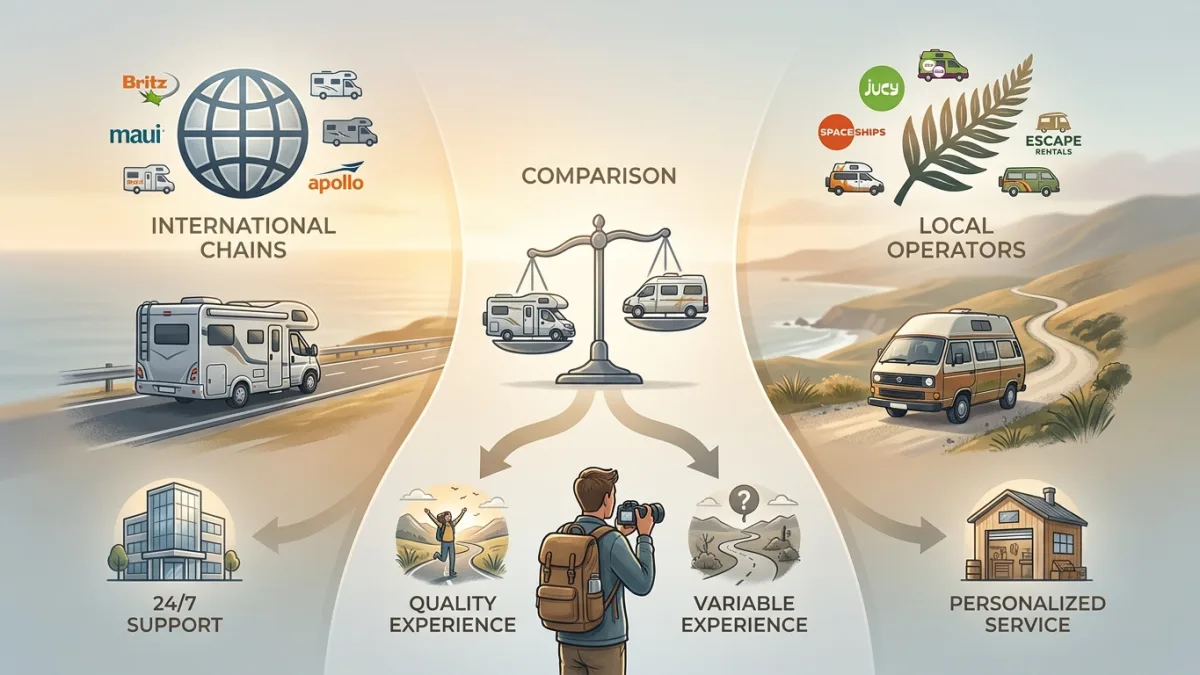
New Zealand has 50+ campervan rental companies ranging from international chains to local operators. Your choice significantly impacts vehicle quality, support, and overall experience.
>>> CHECK OUT CURRENT PRICES <<<
Major Operators vs Budget Providers
Major companies (Maui, Britz, Wilderness, Apollo) offer:
- Newer vehicle fleets (2-4 years old average)
- Comprehensive roadside assistance (24/7)
- Multiple pickup/dropoff locations
- Higher prices ($120-250 per day)
- Better insurance options
Budget operators (Spaceships, Jucy, Escape, Lucky) provide:
- Older vehicles (5-10 years old)
- Basic support (business hours only)
- Lower prices ($60-120 per day)
- Limited locations (usually Auckland/Christchurch only)
- Higher excess amounts
For first-time visitors or those wanting peace of mind, major operators justify their premium. Experienced travelers comfortable with basic vehicles and potential mechanical issues can save significantly with budget brands.
What to Check Before Booking
Beyond price, evaluate these factors:
Vehicle age and mileage: Older, high-mileage vehicles (200,000km+) face higher breakdown risk. Ask about average fleet age.
Inclusions: Compare what’s included in base price – bedding, kitchen equipment, camping chairs, GPS, etc. Some “cheaper” rentals require $100-200 in add-ons.
Pickup/dropoff locations: Airport pickups add convenience but often cost $50-100 extra. Depot locations require taxi/uber but save money.
Breakdown support: 24/7 roadside assistance matters when you’re stuck at 8pm on a remote highway. Budget operators often provide business-hours-only support.
Reviews and reputation: Check recent reviews (within 6 months) on Google, TripAdvisor, and Rankers. Look for patterns in complaints about vehicle condition, hidden fees, or poor customer service.
Reading the Fine Print
Rental agreements contain critical details easily overlooked:
- Prohibited roads: Some companies ban vehicles from specific roads (Skippers Canyon, Ball Hut Road, etc.). Violating this voids insurance.
- Minimum rental periods: Peak season often requires 5-7 day minimums.
- Cancellation policies: Flexible rates allow free cancellation, cheaper rates may be non-refundable.
- Damage assessment: How does the company evaluate damage at return? Some charge for minor scratches, others only for significant damage.
Request the full rental agreement before booking, not just the quote summary. Read it completely, especially sections on insurance, damage, and fees.
Booking Direct vs Comparison Sites
Booking directly with rental companies sometimes offers perks like free upgrades or waived fees, but comparison sites (Motorhome Republic, Compare and Travel) show multiple operators simultaneously and sometimes negotiate exclusive discounts.
Direct booking advantages:
- Direct communication with the company
- Easier to negotiate add-ons or special requests
- Loyalty programs and repeat customer discounts
Comparison site advantages:
- See all options in one search
- Sometimes exclusive discount codes
- Neutral reviews and ratings
Check both options. Compare the final price after all fees and inclusions, not just the daily rate.
Practical Tips for First-Time Campervan Travelers
Renting a campervan differs significantly from traditional accommodation. These practical insights help you avoid common first-timer mistakes.
The Pickup Process
Vehicle pickup takes 30-60 minutes. The company inspects the vehicle with you, explains all systems, and processes paperwork. Arrive well-rested, not immediately after a long-haul flight. Jet lag impairs your ability to absorb important information about vehicle operation.
During pickup, verify:
- All existing damage is documented (take photos/video)
- You understand toilet cassette operation
- Gas system works (test the stove)
- Heating system functions
- All included equipment is present
- You’re comfortable driving the vehicle (take a test drive)
Don’t rush this process. Ask questions about anything unclear. A small confusion at pickup becomes a major problem at a remote campsite.
Driving Tips for Large Vehicles
If you’re accustomed to sedans, driving a 6-meter campervan requires adjustment:
Left-side driving: Your instinct will be to drift left. Consciously position yourself (the driver) in the center of the lane. Use the left mirror to maintain distance from the road edge.
Width awareness: Campervans are wider than cars. Allow extra space when passing parked vehicles or on narrow roads. Fold in mirrors when parking in tight spots.
Height clearance: Know your vehicle height (written on dashboard). Watch for low-hanging branches, car park height barriers, and drive-through clearances.
Braking distance: Campervans weigh more and take longer to stop. Double your following distance from other vehicles.
Hill starts: On steep hills, use the handbrake to prevent rolling backward while engaging the clutch (manual) or releasing the brake (automatic).
Daily Routines and Checklists
Successful campervan travel involves simple daily routines:
Morning:
- Empty grey water if tank is 3/4 full
- Check tire pressure weekly
- Secure all loose items before driving
- Close roof vents and windows
Evening:
- Level the vehicle (use leveling blocks if needed)
- Connect to power if at a holiday park
- Check weather forecast for next day
- Plan fuel stops for tomorrow’s route
Every 2-3 days:
- Empty toilet cassette
- Refill freshwater tank
- Restock groceries
- Charge all devices and power banks
Cooking and Food Storage
Campervan kitchens are compact but functional. Most include a 2-burner gas stove, small sink, and mini-fridge (runs on gas or electricity).
Efficient cooking tips:
- Pre-cut vegetables at home or buy pre-cut options
- One-pot meals minimize cleanup
- Use campsite BBQ facilities when available
- Stock up at supermarkets, not convenience stores (50% cheaper)
Food storage reality: Fridge space is minimal (40-60 liters). Shop for 2-3 days maximum, not weekly. In hot weather, fridges struggle to maintain temperature, especially when driving or on battery power.
Sleep Comfort and Temperature Control
Campervan beds convert from seating areas, meaning setup and breakdown daily. This takes 2-5 minutes once you learn the system. Some travelers leave beds made up during multi-day stays at one location.
Temperature management:
- Summer: Park in shade, use roof vents for airflow, consider a small battery-powered fan
- Winter: Use the gas heater (if equipped), sleep in warm layers, crack a window slightly for ventilation
Condensation builds up overnight from breathing and cooking. Wipe down windows each morning to prevent mold growth. Keep a small towel handy for this purpose.
Staying Connected
Most campervans don’t include wifi. You’ll rely on your phone for navigation, campsite booking, and communication.
Connectivity options:
- Local SIM card: $20-50 for tourist plans with 5-20GB data (Spark, Vodafone, 2degrees)
- Portable wifi hotspot: Rent for $8-12 per day with unlimited data
- Holiday park wifi: Usually available but often slow and unreliable
Cell coverage is excellent in cities and towns but drops to nothing in remote areas like Fiordland, parts of the West Coast, and inland regions. Download offline maps (Google Maps allows this) and carry a physical road atlas as backup.
Laundry and Personal Hygiene
Holiday parks provide coin-operated laundry ($4-6 wash, $4-6 dry). Plan laundry every 4-7 days depending on your clothing supply. Bring quick-dry clothing to minimize laundry frequency.
Showers at holiday parks and DOC sites use coin-operated or button-timed systems. Bring $1 and $2 coins. Some facilities offer unlimited hot water, others give 4-6 minutes per payment. Learn to take efficient showers.
Non-self-contained travelers rely entirely on public facilities. Plan your route around towns with public toilets and showers. The CamperMate app shows facility locations.
Managing Costs and Budget Planning
Understanding the complete cost structure helps you budget accurately and avoid financial surprises during your trip.
Complete Cost Breakdown
| Cost Category | Budget Range (2 weeks) | Mid-Range | Premium |
|---|---|---|---|
| Vehicle rental | $840-1,680 | $1,400-2,100 | $2,100-3,500 |
| Insurance/excess reduction | $112-420 | $350-560 | $560-840 |
| Fuel (2,500km) | $375-450 | $450-600 | $600-750 |
| Campsite fees | $0-420 | $280-560 | $420-840 |
| Food/groceries | $280-420 | $420-700 | $700-1,050 |
| Activities/attractions | $200-400 | $400-800 | $800-1,500 |
| TOTAL | $1,807-3,790 | $3,300-5,320 | $5,180-8,480 |
These ranges assume two people traveling for 14 days in a 2-berth campervan. Solo travelers pay the same vehicle/insurance costs but can reduce food and some activity costs.
Money-Saving Strategies
Grocery shopping: Pak’nSave and Countdown supermarkets offer the best prices. Avoid tourist-area convenience stores where prices inflate 50-100%. Stock up in larger towns before heading into remote areas.
Fuel: Download fuel price apps (Gaspy) to find cheapest stations. Prices vary by $0.15-0.30 per liter within the same town. Z Energy and Waitomo often undercut BP and Mobil.
Free activities: New Zealand offers countless free experiences – hiking trails, beaches, scenic lookouts, and natural hot springs. Paid attractions are optional for budget travelers.
Cook your own meals: Restaurant meals cost $15-25 per person for casual dining, $30-50 for nicer restaurants. Cooking in your campervan cuts food costs by 60-75%.
Mix accommodation types: Alternate between free camping (where legal), DOC sites ($6-23), and holiday parks ($30-60) rather than staying at holiday parks every night.
When to Splurge
Some experiences justify higher costs:
Milford Sound cruise: According to Luxe Tours, prices for the 2025/2026 summer season range from $165 NZD to $389 for an adult ticket, with RealNZ offering a premium Milford Sound cruise at $389 per adult ticket. These cruises are genuinely spectacular and difficult to experience otherwise.
Hot pools and thermal experiences: Rotorua’s thermal parks ($25-50) and natural hot pools offer unique New Zealand experiences.
Adventure activities: Bungy jumping, skydiving, or helicopter flights are expensive ($200-400) but once-in-a-lifetime opportunities.
Quality campsite locations: Paying $50-60 for a beachfront holiday park site or one with exceptional views adds value beyond just facilities.
Budget for 2-4 “splurge” experiences during a 2-week trip rather than trying to do everything or nothing.
Emergency Fund
Set aside $500-1,000 for unexpected costs:
- Vehicle repairs or replacement if breakdown occurs
- Medical expenses (even with insurance, copays exist)
- Accommodation if vehicle becomes unusable
- Flight changes due to delays or emergencies
- Fines or penalties (parking, speeding, camping violations)
This fund provides peace of mind and prevents a single problem from derailing your entire trip.
Questions?
If we have left anything aside, that you feel need answering. Please leave a comment and we will get back to you.
Frequently Asked Questions
There’s no single “best” company-it depends on your budget and travel style. Popular options include JUCY, Britz, Spaceship & Travellers Autobarn, various companies offering everything from budget campercars to luxury motorhomes. Most rental operators have bases in Auckland and Christchurch, the locations of New Zealand’s two main airports. Compare reviews, service quality, and what’s included in your rental before booking. Get in touch with us if you want some help.
Most campervans have either a fixed cassette toilet or a portable toilet built in (if self contained). A cassette toilet is fixed to the campervan, but has a portable waste tank that you remove and transport to dump stations. Cassette toilets generally need emptying every one to three days depending on usage, though you can extend this by using one of the many public toilets available. Dump stations are available at holiday parks, DOC campsites, and for free throughout most of New Zealand.
Booking methods vary depending on the type of campsite you choose. Holiday parks, commercial campgrounds, and regional parks require advance booking, while freedom camping is generally first-come, first-served with no booking needed. DOC campsites can be booked online through the DOC booking system, though many operate on a first-come, first-served basis. Download apps like CamperMate to find and compare campsite options easily.
Daily rental costs vary significantly by season and vehicle type. Daily hire rates can range from $100 to over $900 depending on the rental operator, with pricing based on seasons-typically highest from mid-December to February, ranging from NZD $200-$400 per day. Winter rentals (June, July & August) can be as low as $30 per day. Remember to factor in additional costs like insurance, campsite fees, fuel, and Road User Charges for diesel vehicles.
Book 3-6 months in advance for summer travel to secure the best rates. For peak summer, book 3-6+ months ahead for popular models and routes, especially over Christmas/New Year and school holidays. For shoulder seasons (October-November, March-April), 6-10 weeks is usually fine, while winter bookings can work with 2-6 weeks notice. The earlier you book, the lower the price, as rates increase closer to your travel date.
Self-contained campervans have a fixed toilet, water tanks, and waste storage for at least three days. Self-contained vehicles are equipped to meet all your ablutionary and sanitary needs for at least three days without external services, including fresh water, a fixed toilet, and waste tanks. This certification gives you more flexibility and a wider range of options for where you can camp, often leading to serene, off-the-beaten-path locations. Non-self-contained campervans are limited to holiday parks and designated campgrounds only.
Shoulder seasons (March-April and October-November) offer the best balance of weather and pricing. Late October-November or March-April provide the best balance of weather, price, and availability. March-April is the golden window with great weather without peak pricing, while rates can be slashed by up to 50% in shoulder and off-season compared to summer. You’ll enjoy fewer crowds, better availability, and significantly lower daily rates than peak summer months.
Sources for this article
7

Ask us anything
We run this blog so you can have a great time in New Zealand. All the articles and videos are free for anyone.
If you want to ask an individual question about Newzealand, your working holiday or anything else around travelling New Zealand, then this is your chance.
Even it always looks like holiday, this website and the project is a fulltime business. So you can support us with any question if you'd like.
Simply click the button and ask us, in exchange for your answer you can give what you value our time.
If every visitor would support us with 1€ per year, our business would be up running for long times. Therefore we count on your support!
A big thank you from the depth of our hearts. Julian & the team of Project-Newzealand